China Clay Supplier to Bangladesh for Industrial Use
07 October, 2026

01 October, 2026
Consistent raw materials are vital for stable ceramic production. A small change in clay can affect forming, drying, firing, strength, colour, and rejection rates. This makes supplier selection more than a price-based decision.
When choosing a ball clay supplier for ceramic industries in Indonesia, buyers should review both laboratory data and real production results. A clay that performs well in tiles may not suit a sanitaryware casting body. Likewise, a grade used for tableware may need different colour and purity controls.
This guide explains the properties, tests, and sourcing questions that help Indonesian ceramic manufacturers select the right material.
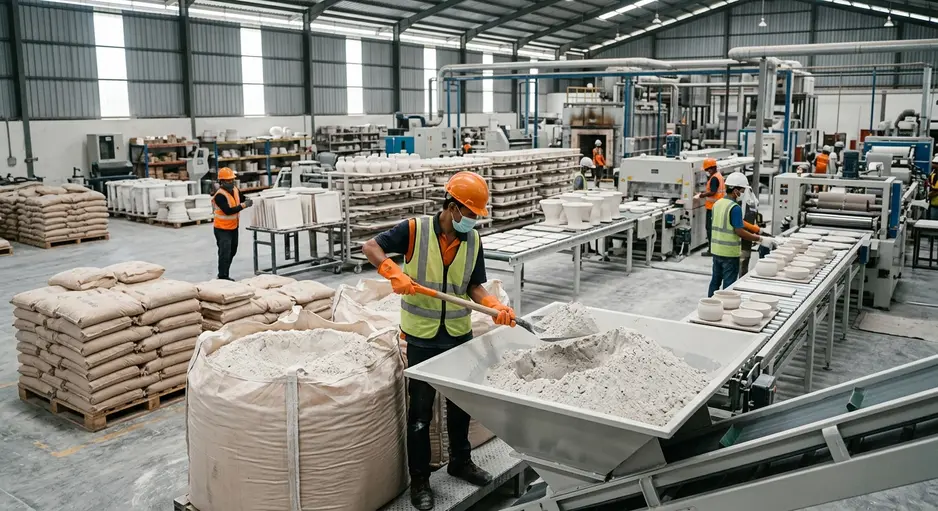
Ball clay is a fine-grained, naturally occurring plastic clay material. It may contain kaolinite, quartz, mica or illitic minerals, organic matter, and small amounts of iron- or titanium-bearing minerals. The exact composition depends on the deposit and grade.
Manufacturers usually blend ball clay with kaolin, feldspar, quartz, and other materials. It is rarely the only clay in a ceramic body formulation. Its main role is to improve workability and bind materials that have lower natural plasticity.
Ball clay is different from kaolin, bentonite, and fire clay. Kaolin is often less plastic and may provide a lighter fired colour. Bentonite can be highly plastic even at low addition rates. Fire clay is selected mainly for its resistance to high temperatures. Each material serves a different purpose.
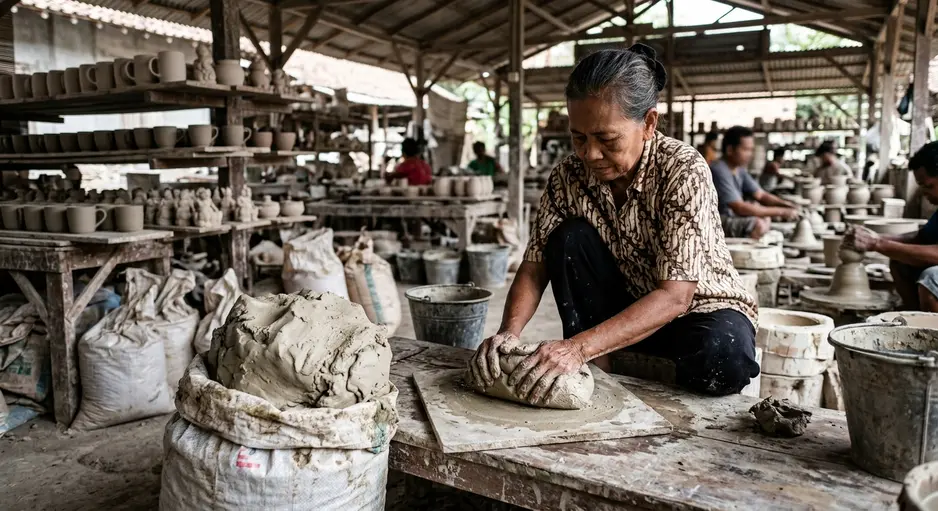
The plasticity of clay helps a moist body hold its shape during forming. It can support pressing, extrusion, shaping, casting, and demoulding. Ball clay also improves green strength, which is the strength of the ceramic body before firing.
Higher green strength can reduce cracks, broken edges, and handling damage. However, more plasticity is not always better. A highly plastic material may increase water demand, drying time, and shrinkage. The correct addition level should be confirmed through testing.
Ball clay influences firing behaviour, including shrinkage, vitrification, strength, absorption, and fired colour. Its performance also depends on the other materials in the body and the plant’s firing cycle.
Chemical analysis alone cannot predict complete ceramic processing performance. Mineralogy, particle shape, organic content, and particle size distribution can cause two clays with similar chemistry to behave differently.
Kaolinite content can provide useful information about the clay’s mineral composition. Yet a higher value does not automatically mean that the material will perform better. Ceramic manufacturers must consider the complete body and process.
Alumina content and silica content affect refractoriness, vitrification, and fired properties. The preferred range varies with the product, firing temperature, and blend of raw materials. Buyers should compare test results with their approved body rather than relying on a universal target.
Iron oxide levels are important for white and light-coloured ceramic products. Iron-bearing minerals can create cream, buff, or darker tones after firing. Tableware and sanitaryware bodies may therefore need tighter impurity limits than darker tile products.
Low iron does not always guarantee a white result. Titanium compounds, organic matter, mineralogy, kiln atmosphere, and interactions with other body materials may also affect fired colour. Test pieces should be fired under the buyer’s actual production conditions.
Moisture content affects delivered weight, storage, feeding, and dosing. High or changing moisture can make batch control more difficult. Buyers should agree on a suitable range and confirm how the supplier measures it.
Particle size distribution influences plasticity, surface area, water demand, rheology, and strength. Very fine particles may improve binding but can also raise water demand. Wet-sieve residue should be checked alongside particle size data because coarse residue may create surface defects or processing issues.
A useful technical review should cover more than oxide percentages. Depending on the application, buyers may request:
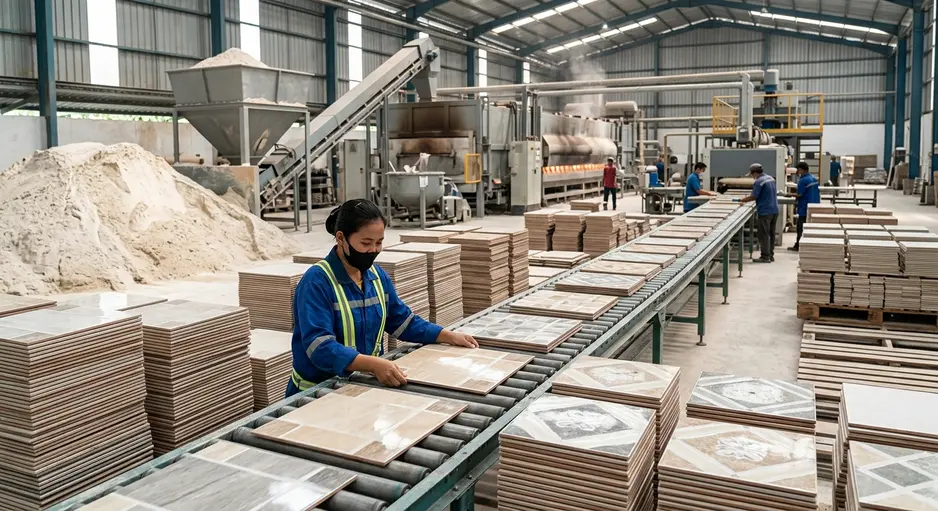
Ball clay for the tiles industry can improve green strength in pressed bodies. This supports edge integrity and reduces breakage when unfired tiles move between pressing, drying, glazing, and kiln loading.
For tile manufacturing applications, manufacturers should balance plasticity with drying speed and shrinkage. Residue must also be monitored because coarse particles can contribute to surface faults. Fast-firing bodies need testing at the plant’s actual peak temperature and cycle.
Floor tiles, wall tiles, porcelain tiles, and large ceramic slabs do not always use the same grade. Forming pressure, thickness, water content, and target colour can change the required properties.
Buyers evaluating ball clay for sanitaryware Indonesia should pay close attention to slip behaviour. Important factors include viscosity, deflocculation response, casting rate, particle distribution, and stability during storage and use.
The clay should also provide adequate strength after demoulding. This helps large or complex pieces withstand handling and drying. Fired colour, shrinkage, cracking risk, and shipment consistency should be checked before approval.
Ball clay for tableware often requires controlled fired colour and low levels of colouring impurities. Fine particle distribution can support smooth forming and surface development, while sufficient strength helps producers make thinner items without excess damage.
Tableware bodies may be formed by pressing, casting, or plastic shaping. Each method places different demands on the clay. For this reason, laboratory results should be followed by a forming and firing trial.
Usually, one grade will not perform equally well in every process without formulation changes. A clay that provides strong pressed tiles may not have ideal casting rheology. A white-firing grade may also have different plasticity or cost considerations.
A ball clay supplier for ceramic manufacturers should discuss the application, forming method, firing temperature, and target properties before suggesting a grade.
A technical data sheet normally provides typical values or a declared range. A certificate of analysis, or COA, reports results for a specific batch or shipment. Buyers should request both when comparing materials.
Check the stated test methods, analysis frequency, lot number, and traceability system. Typical values should not be treated as guaranteed shipment limits unless this is clearly agreed with the supplier.
An industrial ball clay supplier should be able to discuss the properties relevant to the intended use. Buyer qualification tests may include plasticity, residue, green strength, drying sensitivity, rheology, fired shrinkage, absorption, strength, and colour.
Testing at more than one firing temperature can reveal changes across the operating range. This is useful when a kiln has normal process variation or the material may be used in several product lines.
Before placing a large order, ask how the clay is mined, selected, blended, and tested. Useful questions include:
A ball clay exporter to Indonesia should clarify available packaging and loading options. Depending on the shipment, buyers may need industrial bags, jumbo bags, moisture protection, palletization, or container-loading controls.
Commercial documents may include an invoice, packing list, certificate of origin, and shipping paperwork. Exact requirements should be confirmed for the product, shipment route, and Indonesian import process.
A clear request for quotation helps the supplier assess technical and commercial needs. Include:
Compare the proposed ball clay raw material for Indonesia with the clay already approved by the plant. Confirm moisture and residue first, followed by chemical analysis where needed. Mineralogical testing can provide added detail when chemistry does not explain processing differences.
Measure plasticity and particle size, then prepare test bars, tiles, or cast pieces. After firing, compare shrinkage, absorption, strength, dimensions, defects, and colour.
Replace the current clay in stages rather than changing the full formulation at once. Keep water addition, deflocculant level, forming pressure, drying conditions, and firing curve as stable as possible.
Record scrap, breakage, cracks, casting behaviour, glaze interaction, fired size, and production speed. A successful laboratory result is helpful, but a controlled plant trial gives stronger evidence of practical suitability.
Tile example: A highly plastic clay may improve press strength but increase drying shrinkage. Reducing its addition or rebalancing non-plastic materials may provide a better result.
Sanitaryware example: A clay may have acceptable whiteness but require too much deflocculant. A casting trial can show whether it causes unstable viscosity or a slow casting rate. These are illustrative examples, not customer case studies.
Importers should verify the correct customs classification, duty and tax treatment, licensing, product description, and documentation before shipment. Ball clay may fall within a broader clay classification, but the exact code must be confirmed for the product and jurisdiction.
Requirements can change. Work with a qualified customs professional and check the applicable Indonesian import system before approving shipping documents.
The lowest material quote may not deliver the lowest production cost. Compare the material price with inland transport, ocean freight, insurance, port charges, customs costs, and delivery to the plant.
Also account for moisture-adjusted usable material, production yield, energy use, defects, and scrap. A consistent clay that reduces breakage may offer better value than a cheaper material with unstable ceramic processing performance.
Transit time depends on the origin, destination port, sailing schedule, container availability, and customs clearance. Buyers should also allow time for sampling, technical approval, order preparation, and loading. Ask the exporter for a shipment-specific estimate rather than relying on a fixed general lead time.
Indonesian buyers looking for ball clay for ceramic manufacturing can visit Jay Ganesh Minerals to review available information and make a direct enquiry.
When contacting the company, request the latest technical data, recent analysis, sample availability, packaging options, minimum order quantity, and export terms. Share your ceramic application and required limits so the discussion is based on practical production needs.
For a useful quotation, include the expected volume, destination port, preferred packaging, firing conditions, and sample quantity. This gives the supplier a clearer basis for responding.
Ball Clay Supplier in Indonesia
Selecting a reliable ball clay supplier for ceramic industries in Indonesia requires more than checking chemical values or price. Buyers must assess mineral composition, moisture, particle size, plasticity, green strength, firing behaviour, fired colour, and consistency.
The safest approach is to review current technical documents, test a representative sample, and run a controlled production trial. For supply discussions, contact Jay Ganesh Minerals with your application, required specifications, monthly volume, destination port, and trial needs.
It improves plasticity, workability, and unfired strength. It can support pressing, casting, extrusion, shaping, drying, and handling within a balanced ceramic body.
No. Both may contain kaolinite, but they can differ in plasticity, particle characteristics, impurities, colour, and their role in a ceramic formulation.
The right grade depends on press behaviour, green strength, residue, drying shrinkage, firing cycle, and target colour. A production trial is needed to confirm suitability.
Key properties include rheology, casting rate, deflocculation response, particle size, green strength, drying performance, fired colour, shrinkage, and lot consistency.
Grade selection or blending may help achieve a target range. Actual capability depends on deposit geology, processing controls, available grades, and order volume.

Whatsapp Chatx
Hi! Click one of our representatives below to chat on WhatsApp or send us email to jrt@jayganeshminerals.com

|
Mr. RAJESH +91 99130 87000 |
|
|
Mr. JIGNESH +91 89800 70055 |