China Clay Supplier to Bangladesh for Industrial Use
07 October, 2026

09 September, 2026
The ball clay vs plastic clay comparison can be confusing because the terms do not always describe two separate mineral categories. Ball clay is a recognized geological and industrial clay. Plastic clay is often a wider term for clay that becomes workable and holds its shape when mixed with water.
This difference matters in ceramic production. A clay that feels easy to form may still cause high shrinkage, slow drying, poor fired color, or casting problems. Manufacturers should compare composition, particle size distribution, green strength, water demand, firing behavior, and consistency before selecting a grade.
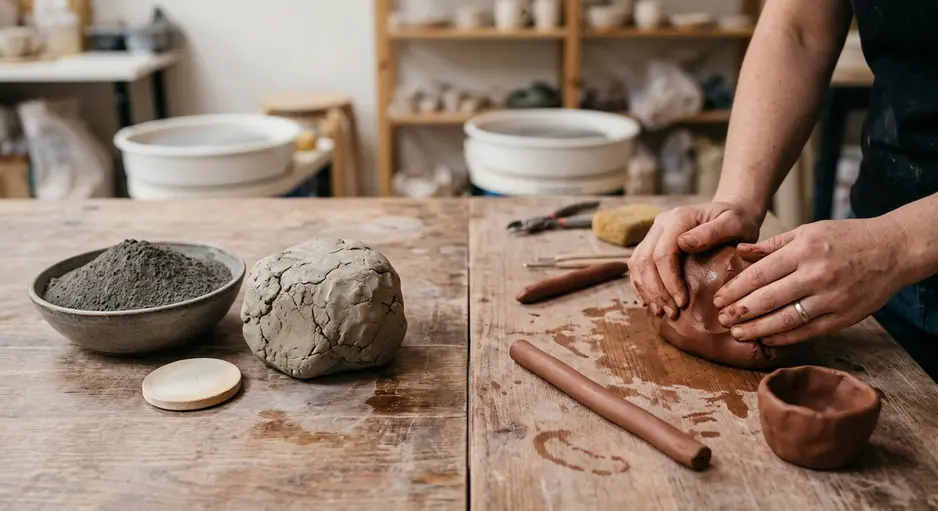
Ball clay is generally a fine-grained, secondary sedimentary clay. It was moved from its original source and deposited in another location through natural geological processes. Its exact composition changes with the deposit and grade.
Typical constituents include kaolinite, mica or illite, quartz, organic matter, and varying amounts of iron and titanium compounds. These materials affect plasticity, raw color, fired color, shrinkage, and the firing temperature range.
The historical name came from an early extraction method in which workers cut the clay into rounded blocks or “balls.” Today, it refers to an industrial clay category rather than the physical shape of the supplied material.
Plasticity is the ability of wet clay to deform under pressure, retain its new shape, and resist cracking. A plastic clay may be a ball clay grade, plastic fire clay, common clay, beneficiated material, or formulated blend.
Its mineral content and ceramic performance can vary greatly. One product may fire light and have high green strength. Another may contain more iron oxide, fire red or buff, and suit structural ceramics better than whiteware.
Fine clay particles provide a large surface area for interaction with water. This can improve cohesion, moldability, and binding power. It also tends to raise water demand, which may increase drying time.
Particle size alone does not control plasticity. Kaolinite content, particle shape, illite, organic matter, soluble salts, and moisture all influence how clay behaves during forming.
Green strength is the strength of a shaped ceramic body before firing. Strong green ware is easier to handle during pressing, extrusion, jiggering, trimming, glazing, and kiln loading.
Ball clay properties often make it useful as a binding component. However, excessive plasticity can make a body sticky, raise power use during forming, and slow the drying cycle. Good workability requires balance rather than the highest possible plasticity.
Quartz content normally acts as a non-plastic part of the clay. In a balanced formulation, it can help limit drying shrinkage. Its particle size and amount must still be controlled to reduce cracking and firing defects.
Organic matter may affect raw color, loss on ignition, deflocculation, and gas release during firing. Iron and titanium compounds are important because they can change fired color. Low levels are often preferred for light ceramic bodies, but the acceptable limits depend on the finished product.
Fine ball clay can need considerable water to reach the required forming consistency. More water must then leave the body during drying. If moisture escapes unevenly, the product may crack, warp, or develop internal stress.
Plastic clay processing characteristics cannot be predicted from the product name. Manufacturers should measure water demand and observe drying characteristics under controlled conditions. The test piece should have a thickness and shape close to the intended product.
Drying shrinkage happens as water leaves the formed body. Firing shrinkage occurs as minerals react and the body becomes denser in the kiln. Total shrinkage combines both stages.
A highly workable clay may still be unsuitable if it causes poor dimensional control. Ceramic body formulation often balances plastic clay with kaolin, quartz, feldspar, calcined clay, or other non-plastic materials and fluxes.
Slip casting depends on viscosity, thixotropy, casting rate, suspension stability, and deflocculant demand. A highly plastic clay does not automatically deliver the best casting performance.
Very fine particles may slow casting, while organic matter and soluble salts can alter rheology. Sanitaryware producers often seek a grade that combines green strength with stable slip behavior and practical casting times.
Firing tests should measure porosity, water absorption, strength, color, shrinkage, and deformation. Results depend on the complete body recipe, kiln atmosphere, heating rate, peak temperature, and soaking time.
Testing clay alone provides useful comparison data, but it does not show the full production response. Fired test bars should also be made from the intended formulation and processed at actual kiln temperatures.
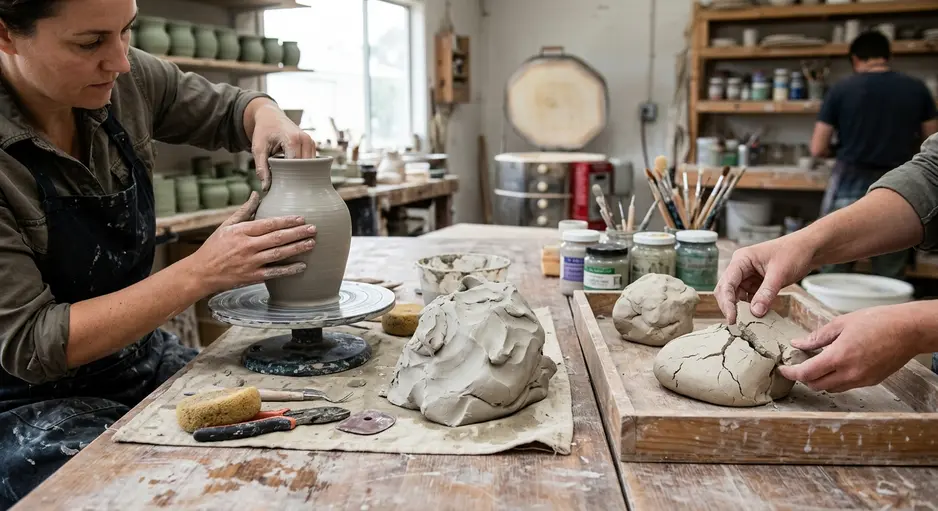
Ball clay applications include ceramic bodies for sanitaryware, wall and floor tiles, tableware, electrical porcelain, pottery, and selected technical or refractory products. Suitable grades may also be used in controlled amounts in glazes and engobes.
Ball clay is usually one part of a body rather than the whole recipe. Its main role is to add bonding strength, improve forming, support suspension, and help less-plastic materials hold together.
Plastic clay uses can include pottery, sculpting bodies, extruded products, bricks, structural ceramics, tiles, and traditional ware. Some specified grades also work in blended whiteware bodies.
Suitability depends on chemical composition and fired performance. A plastic grade that works well in red bricks may not meet the color, residue, or firing needs of sanitaryware and light-colored tiles.
Ball clay and plastic clay for ceramic bodies provide cohesion and shape retention. They are often combined with kaolin for whiteness and refractoriness, feldspar for fluxing, and quartz or silica for dimensional balance.
The final recipe must balance workability, drying speed, green strength, vitrification, fired color, absorption, and cost. Improving one property can weaken another, so formulation changes should be tested as a complete system.
Ball clay may be preferred when a manufacturer needs high green strength, fine particles, strong body cohesion, or stable casting performance from a qualified ceramic grade. It can be especially useful when less-plastic raw materials need better binding.
A specified plastic clay may be suitable when local availability, delivered cost, extrusion behavior, lower water demand, or a particular fired color is more important. Neither option is automatically better for ceramic production.
The right choice depends on the forming process, recipe, color target, shrinkage tolerance, firing cycle, defect rate, and supply consistency.
Tile manufacturers usually prioritize repeatable shrinkage, pressing behavior, powder strength, residue, moisture control, and fast-firing compatibility. Iron oxide and titanium levels also matter in light-colored bodies.
A vitrified tile recipe may use a controlled amount of low-iron ball clay for binding strength. Feldspar provides much of the fluxing action, while quartz and other non-plastic materials help maintain dimensional balance.
A general plastic grade may also work if testing confirms low defect rates and stable dimensions. The commercial name alone is not enough to make that decision.
Ball clay can be used alone for laboratory tests or a limited specialty purpose, but it is generally unsuitable as a complete production body. Its fine particles and high water demand may lead to excessive shrinkage, slow drying, cracking, warping, or firing variation.
Standard references from the U.S. Geological Survey, British Geological Survey, and established ceramic engineering publications can provide useful background. Supplier data must still be confirmed in the buyer’s own formulation.

A useful supplier comparison should cover more than a favorable sample. Buyers should request deposit or origin information, XRF and XRD reports, particle-size data, moisture, loss on ignition, shrinkage, green strength, and fired color at relevant temperatures.
It is also important to review monthly supply capacity, packaging options, certificates of analysis, quality controls, sample availability, and support for pilot orders. Several batches should be checked before long-term approval.
When contacting Jay Ganesh Minerals, request current specifications, samples, packaging details, and guidance for your intended ceramic body, tile, pottery, or industrial application. Final approval should follow laboratory and production trials.
Explore Ball Clay & Plastic Clay
Ball clay is a recognized industrial clay category, while plastic clay is often a broader description based on workability. The right choice depends on composition, plasticity, green strength, shrinkage, rheology, fired color, firing behavior, and batch consistency.
Technical data can narrow the options, but production trials provide the final answer. Contact Jay Ganesh Minerals to request current specifications, samples, packaging information, and application-focused guidance before evaluating a grade in your ceramic process.
Ball clay is generally more plastic because of its fine particles and mineral characteristics. Kaolin is often less plastic but is valued for properties such as refractoriness and fired whiteness. Actual performance varies by grade.
No. Ball clay is normally plastic, but plastic clay may describe fire clay, common clay, beneficiated material, or a formulated blend. Buyers should verify the product’s mineralogy and test data.
It can improve cohesion, workability, green strength, suspension, and forming performance. Its addition must be balanced against higher water demand, drying time, and shrinkage.
Not always. Some grades fire near-white or cream, while others become buff or darker. Iron, titanium, organic matter, kiln atmosphere, and firing temperature affect the result.
Its fine particles and high plasticity can increase water demand, drying shrinkage, and drying time. An unbalanced body may be more likely to crack, warp, or change dimensions.

Whatsapp Chatx
Hi! Click one of our representatives below to chat on WhatsApp or send us email to jrt@jayganeshminerals.com

|
Mr. RAJESH +91 99130 87000 |
|
|
Mr. JIGNESH +91 89800 70055 |