Kaolin Clay Exporter & Supplier from India to UAE
02 November, 2026

07 October, 2026
China clay, also known as kaolin, is an important raw material for many manufacturing industries in Bangladesh. It is used in ceramics, paper, paint, rubber, plastics, putty, adhesives, and other products. However, each application needs a different grade and performance profile.
India’s location offers practical sourcing options for Bangladeshi importers. Buyers can compare processed grades, packing formats, transport routes, and delivery terms. This guide explains how to select a grade, review technical data, plan imports, and request an accurate quote. Buyers evaluating a china clay supplier to Bangladesh may also contact Jay Ganesh Minerals to discuss suitability and commercial terms.
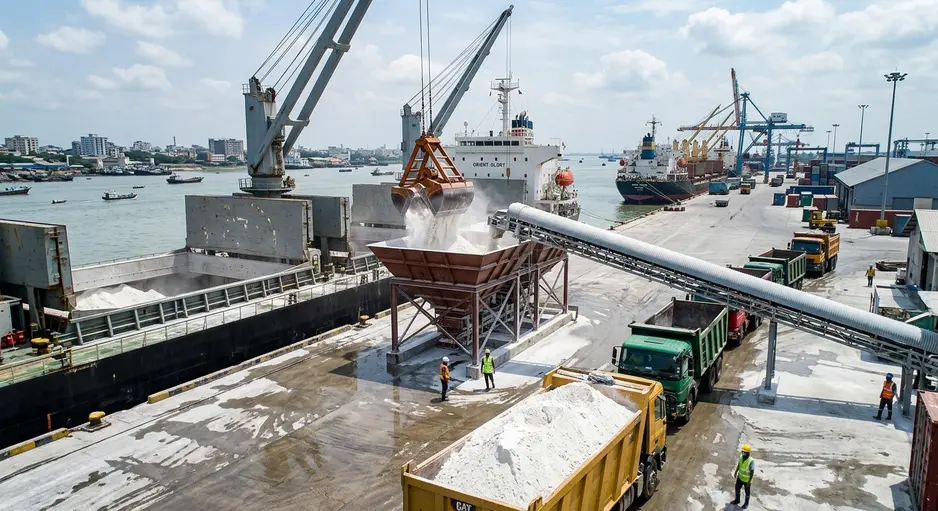
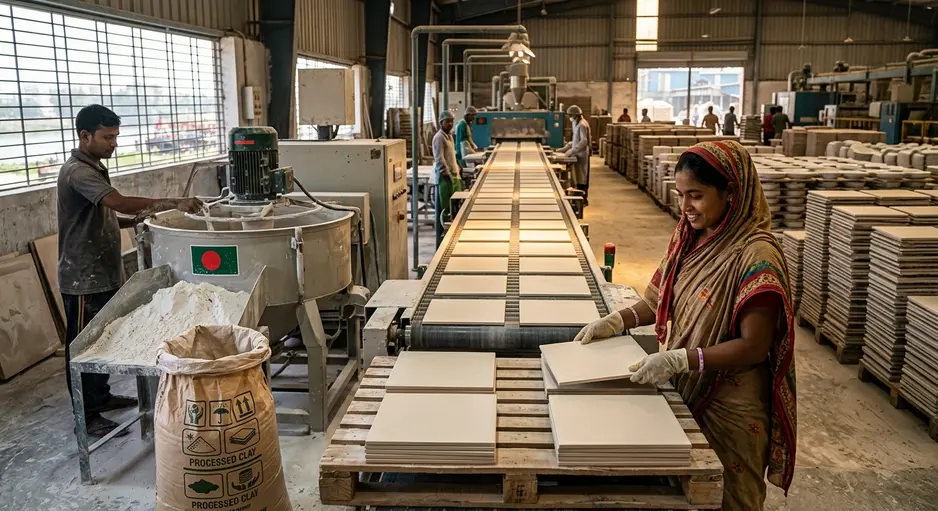
Manufacturers in Bangladesh use kaolin in tiles, sanitaryware, tableware, paper, coatings, rubber goods, and general industrial products. In these sectors, mineral quality can affect production speed, surface finish, colour, strength, and rejection rates.
Reliable supply matters as much as initial quality. A material that changes between shipments can force a factory to adjust its formula or process settings. For this reason, experienced buyers often value repeatable quality over the lowest price per tonne.
India’s proximity may provide shorter and more flexible transport options than distant sources. Depending on the loading point and destination, material may move by road, rail, land port, or sea. Nearby supply can also make sample testing and repeat ordering more practical.
A china clay supplier India buyers consider should be able to discuss processing, packing, monthly volume, testing, and dispatch planning. The selected route must match the order size, urgency, handling needs, and landed-cost target.
The main mineral in kaolin is kaolinite, a hydrated aluminium silicate represented by the formula Al₂Si₂O₅(OH)₄. Natural deposits may also contain quartz, mica, iron-bearing minerals, and other impurities. Their presence can affect colour, abrasion, firing performance, and finished-product quality.
A chemical report alone does not provide the full picture. Buyers should review the clay mineral composition together with physical properties and actual performance in their production process.
Whiteness describes visual appearance, while brightness is measured under a defined test method. The two values should not be treated as identical. High brightness may be important for paper and light-coloured coatings, while fired whiteness is more relevant to many ceramic products.
Low iron oxide content is often preferred for white ceramic bodies and pale formulations. However, there is no universal limit for every application. The acceptable value depends on the product, formula, firing cycle, and desired colour.
Particle size distribution can influence smoothness, opacity, dispersion, residue, abrasion, and surface finish. Very fine material may perform well in one formula but create viscosity or handling issues in another. Buyers should request test methods and units when comparing reports.
Moisture content affects usable dry mineral weight, storage, flow, and transport economics. A low quoted price may be less attractive if the material contains more water than the approved benchmark.
Alumina and silica content are important in ceramic formulations, but they should be assessed with plasticity, residue, loss on ignition, shrinkage, and firing behaviour. For paints and rubber, pH, oil absorption, fineness, and dispersion may be more useful indicators.
China clay is used as a ceramic raw material in tiles, tableware, sanitaryware, and related products. Buyers may assess fired whiteness, plasticity, drying shrinkage, water absorption, strength, residue, and iron or titanium content.
A ceramic manufacturer should not approve a grade from chemical composition alone. A plant trial may reveal differences in casting behaviour, drying, fired colour, strength, or glaze compatibility. These results may not be clear from a standard laboratory report.
Kaolin may be used as a filler or in paper coating applications. It can contribute to opacity, smoothness, printability, brightness, and ink receptivity. Coating grades and filler grades may need different particle profiles and performance properties.
Paper manufacturers commonly assess particle size, brightness, abrasion, viscosity, and dispersion. The approved material must work with the mill’s equipment, chemicals, and target paper quality.
In paint and coating applications, china clay can serve as a functional extender. Depending on the formula, it may influence sheen control, suspension, opacity, film properties, surface finish, and overall formulation cost.
Useful checks include fineness, oil absorption, brightness, pH, moisture, and dispersion. A grade suitable for one water-based paint may not perform the same way in a solvent-based system.
Rubber filler applications may use kaolin to support processing, hardness, dimensional stability, surface finish, or cost control. It may also be considered for plastics, putty, adhesives, sealants, cables, and construction formulations.
The effect depends on particle size, surface properties, loading level, and compatibility with other ingredients. Buyers seeking a china clay supplier for industrial use should always state the exact product and process.
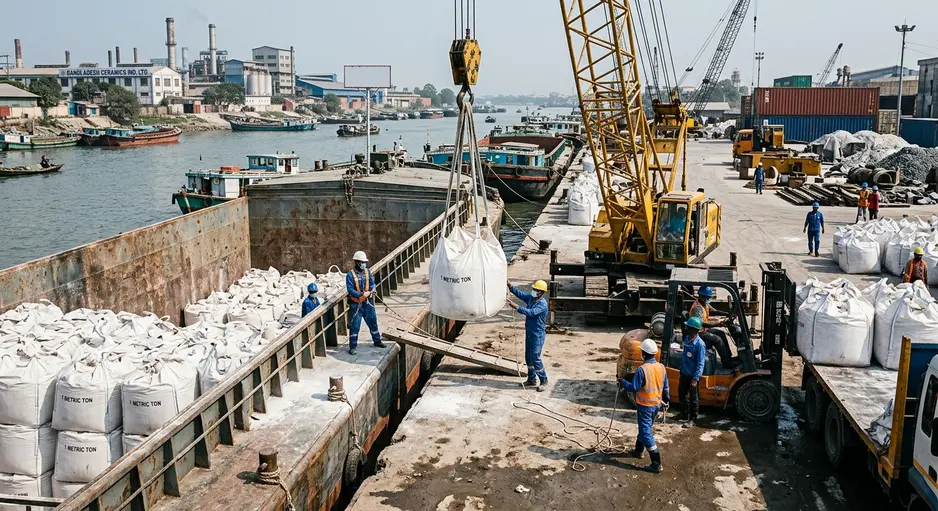
Refined china clay may be washed, classified, cleaned, dried, and milled through controlled industrial mineral processing. Depending on the deposit and process, refining can improve consistency, reduce residue, control particle size, and support better brightness.
Refined grades may be suitable for ceramics, paper, paints, rubber, and other manufacturing uses. Final selection should still depend on the technical specification and production trial.
Calcined kaolin is produced by heating kaolin under controlled conditions. This changes its mineral structure and performance. Selected grades may provide better opacity, brightness, electrical properties, reinforcement, or different shrinkage behaviour.
Calcination does not make a product automatically better. It makes it different. Some ceramic processes need the plasticity of uncalcined clay, while selected paint, paper, polymer, or electrical applications may benefit from calcined material.
No. Refined china clay is cleaned and physically processed while retaining its basic clay structure. Calcined kaolin receives controlled heat treatment that changes its structure and properties. The correct choice depends on the required opacity, plasticity, dispersion, reinforcement, and process behaviour.
Ask for a technical data sheet or recent test report before discussing a large shipment. The report should use clear units and test methods so that results can be compared with the buyer’s current material.
Begin with laboratory testing, followed by a pilot or production-line trial. Compare the sample with the current grade under the same conditions. Keep a sealed reference sample after approval so future deliveries can be checked against it.
Ask where the clay is sourced, how it is refined or milled, and whether each batch is tested before dispatch. Confirm monthly capacity, typical production lead time, and the process used to handle complaints or off-spec material.
Common options may include 25 kg or 50 kg bags and jumbo bags. Buyers should specify moisture protection, pallet needs, bag markings, container loading, and unloading limits. Packing must remain suitable throughout transport and storage.
Buyers considering Jay Ganesh Minerals as a china clay exporter to Bangladesh should share their end use, target parameters, quantity, packing format, and delivery point. This helps the company assess the request and prepare an application-relevant offer.
Kaolin and other kaolinic clays are commonly placed under HS heading 2507. The importer should confirm the exact subheading, current duties, VAT, supplementary charges, permits, and documentation with Bangladesh Customs or a licensed clearing agent before shipment.
Rates and requirements can change. They should be checked when the purchase order is prepared rather than copied from an older shipment.
Possible options include land-port movement from India or container shipment through Chattogram or Mongla. The right route depends on the supplier’s location, final destination, volume, urgency, handling cost, and border or port conditions.
Commercial offers should clearly state the Incoterm, such as EXW, FCA, FOB, or CFR. Buyers should confirm which party pays for freight, insurance, clearance, unloading, and local transport.
Delivery time depends on the loading point, production schedule, shipment mode, border or port clearance, and destination in Bangladesh. Ask the exporter to show production lead time and estimated transit time separately. Extra time should be allowed for testing, documentation, and customs checks.
Compare material price, packing, inland transport, freight, border or port charges, customs, taxes, and clearing costs. Also consider dry mineral value and the possible cost of rejects, delays, or inconsistent batches.
China Clay Supplier to Bangladesh
Successful sourcing is not simply about finding the lowest price. Buyers should evaluate composition, brightness, particle size, moisture, iron content, processing method, packing, and delivery terms. Laboratory testing and production trials remain essential because performance can vary by formulation.
For a technically relevant quotation, send Jay Ganesh Minerals your required grade, end use, test limits, monthly quantity, packing preference, and destination in Bangladesh through https://jayganeshminerals.com/. Final approval should always be based on current test data and a plant trial.
China clay is used in ceramics, paper, paints, coatings, rubber, plastics, putty, adhesives, sealants, cables, and construction products. Its role may include improving whiteness, smoothness, opacity, processing, surface finish, dimensional stability, or formulation cost.
The best grade depends on fired whiteness, plasticity, shrinkage, residue, iron content, strength, water absorption, and the ceramic body formula. Laboratory checks should be followed by a production trial under normal firing conditions.
China clay and kaolin clay are often used as interchangeable trade terms. However, products can differ in mineral composition, impurities, particle size, brightness, moisture, and processing method. Buyers should compare specifications rather than relying only on the product name.
Yes, buyers should request a representative sample before a bulk order. Test it in the laboratory and on the production line. Keep part of the approved sample as a reference for checking future commercial batches.
The minimum order depends on the supplier, grade, packing, and transport method. Full truckload or container quantities may offer better freight economics, while smaller trial quantities may be handled differently. Confirm the available option directly with the exporter.

Whatsapp Chatx
Hi! Click one of our representatives below to chat on WhatsApp or send us email to jrt@jayganeshminerals.com

|
Mr. RAJESH +91 99130 87000 |
|
|
Mr. JIGNESH +91 89800 70055 |