China Clay Supplier to Bangladesh for Industrial Use
07 October, 2026

02 November, 2026
UAE manufacturers use kaolin in ceramics, paper, paint, coatings, rubber, and plastics. Yet choosing a kaolin clay exporter from India to UAE involves more than comparing the price per tonne. Buyers must also review purity, particle size, moisture, brightness, packaging, and shipment terms.
A dependable supply arrangement should deliver consistent material from one shipment to the next. Clear technical documents and agreed quality limits are just as important. Jay Ganesh Minerals can be considered by UAE buyers seeking information about Indian kaolin clay. Product grades, specifications, capacity, samples, and export terms should be confirmed directly before an order is placed.
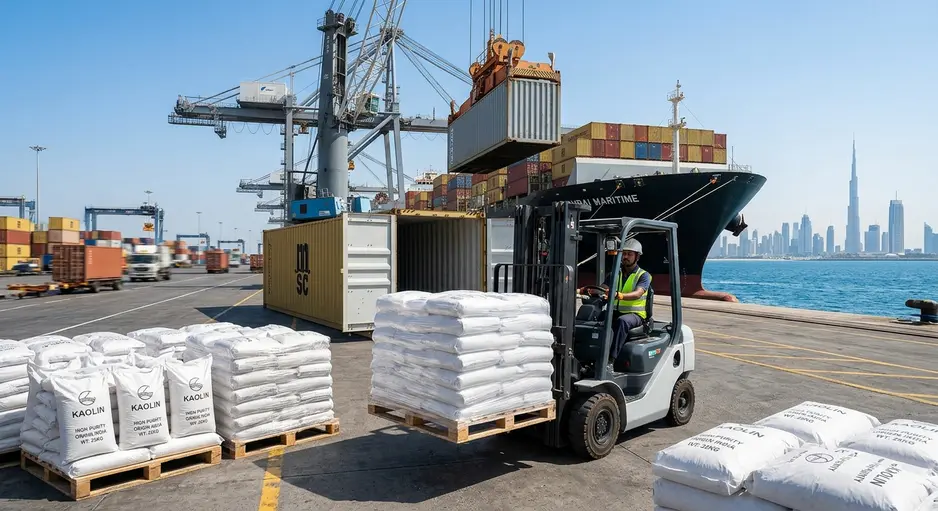
India is a practical sourcing market for processed industrial minerals. Its commercial shipping links with the UAE can support sample orders, container loads, and repeat supply programs. UAE buyers may arrange delivery to Jebel Ali, Khalifa Port, Sharjah, or another agreed destination.
Kaolin can be processed in several ways to meet different production needs. Common options in the wider market include hydrous, washed, micronized, and calcined material. However, availability varies by processor. Buyers should confirm the exact grade, production method, and specification before requesting a quotation.
Some applications need fine particles and high brightness. Others depend more on plasticity, suspension, or firing behaviour. A grade that works in ceramic bodies may not offer the right performance for paper coating or paint.
The lowest ex-works price does not always produce the lowest total cost. Freight, insurance, customs handling, packaging, port fees, testing, and inland transport all affect landed value. Production waste caused by unstable quality can add even more expense.
Kaolinite has the ideal chemical formula Al₂Si₂O₅(OH)₄. Natural clay deposits may also contain quartz, mica, iron-bearing minerals, and other materials. For this reason, the mineral name alone does not prove that a product is suitable for a particular process.
Buyers should review the kaolin mineral composition and purity shown in a recent certificate of analysis. Results should be assessed together with application trials and the test methods used by the laboratory.
Alumina and silica content can affect ceramic body behaviour and performance during firing. Iron oxide concentration is also important. A lower level is often preferred for white ceramics, porcelain, paper, and other products where colour is critical.
Test values from different laboratories may not be directly comparable. Buyers should ask whether the same sample preparation and test method were used. The acceptable range should then be written into the purchase specification.
Particle size distribution affects dispersion, surface finish, opacity, rheology, and processing. An average particle size does not always provide enough information. Buyers may also need the percentage of particles below selected micron sizes and the amount of coarse residue.
Moisture content specifications matter for handling, storage, dosing, and net dry material calculations. Excess moisture can increase freight cost and cause flow problems. It can also affect dry blending and formulation accuracy.
Brightness, whiteness, and fired whiteness describe different properties. They should not be treated as equal values. Paper and coating buyers often focus on measured optical performance, while ceramic buyers also need to check the colour after firing.
A ceramic plant should fire a representative sample at its normal temperature and cycle. This gives a more useful result than relying only on a technical data sheet.
Plasticity and suspension properties can influence ceramic forming, casting, glaze stability, and slurry behaviour. Useful checks may include viscosity, residue, casting rate, shrinkage, and green strength. Testing the material in the buyer’s own formulation is the safest approval method.
Hydrous kaolin keeps its natural hydroxyl structure. It is commonly considered for ceramic bodies, paper filling, paints, rubber, and plastics. Its value depends on factors such as dispersion, plasticity, particle size, colour, and cost.
Calcined kaolin is made through controlled heat treatment. This process changes the mineral structure and can alter brightness, opacity, hardness, and other functional properties. It may be selected for coatings, paints, plastics, rubber, refractory mixes, and specialty formulations.
Neither grade is better for every use. The correct choice depends on the desired performance, production method, formulation, and cost target. A UAE buyer should define the application, request a representative sample, and complete laboratory trials before approving bulk supply.
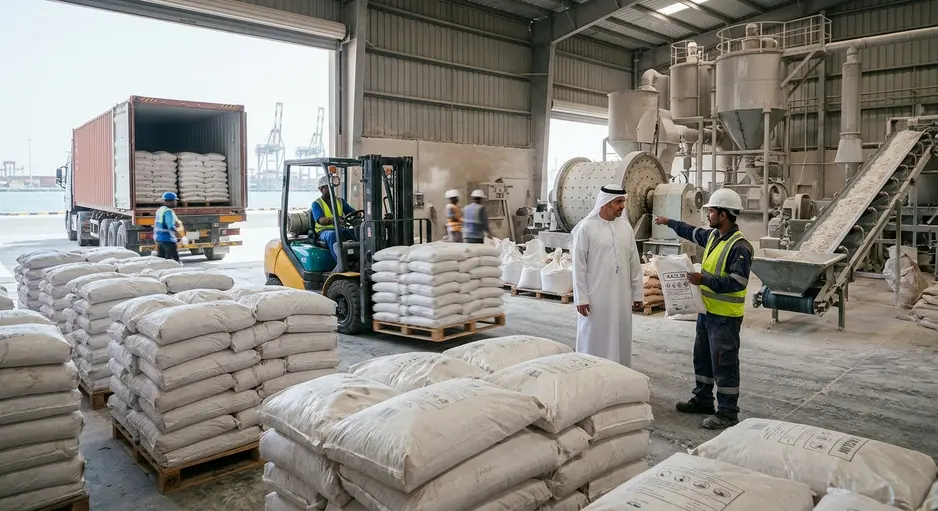
Kaolin is used in ceramic body and ceramic glaze formulation. It can contribute to plasticity, suspension, forming behaviour, and fired properties. Product selection may differ for tiles, tableware, porcelain, glazes, and sanitaryware.
For porcelain and sanitaryware production, chemical composition is only one part of approval. A sanitaryware plant should also test slurry viscosity, casting rate, green strength, shrinkage, firing colour, and glaze compatibility.
A buyer seeking kaolin clay supply for a UAE ceramic manufacturer should provide its firing temperature, forming process, iron limit, residue limit, and desired colour. These details help a supplier identify whether an available grade may be suitable.
Paper coating and filling applications depend on brightness, particle size, opacity, abrasion, dispersion, and viscosity. Filler-grade and coating-grade products may have different performance needs. A paper mill should therefore test retention, runnability, print response, and surface quality.
When evaluating a kaolin clay supplier for a UAE paper manufacturer, buyers should request both optical and physical data. The test method should be stated because brightness and whiteness levels can vary with the method and instrument.
Kaolin can serve as a functional extender in selected paint systems. It may support rheology, suspension, sheen control, film properties, and barrier performance. It is not a direct replacement for every pigment, so its value must be checked within the complete formulation.
Rubber and plastic filler applications may use kaolin to support dimensional stability, processing, surface finish, reinforcement, or selected electrical properties. Results depend on particle size, moisture, compatibility, dispersion, and any surface treatment.
Quality testing and mineral grading should be reviewed before commercial approval. A professional evaluation should cover more than one selected sample. Buyers should compare several lots where possible and agree on acceptable tolerances.
Ask a prospective supplier or kaolin clay export company for:
Buyers should confirm whether a business acts as a kaolin clay manufacturer, processor, exporter, or trader. They should also ask about regular grades, monthly capacity, processing steps, contamination controls, and the ability to maintain agreed limits.
Do not assume that all products shown by a supplier are always available. Current specifications, lead times, export experience, and production capacity should be verified in writing.
UAE buyers can contact Jay Ganesh Minerals through its official website to request current product information. Any decision should be based on verifiable documents, representative samples, commercial terms, and successful application trials.
Before describing the company as a manufacturer or confirming specific export capabilities, buyers should request supporting records. The same care should be used when reviewing stated grades, facilities, certifications, capacity, and past markets.
Kaolin clay export pricing depends on the grade, processing route, purity, brightness, particle size, quantity, and packaging. Freight, destination port, inspection, payment terms, currency, and the selected Incoterm also affect the final quotation.
EXW, FOB, CFR, and CIF quotations include different costs and responsibilities. Buyers should compare offers on the same basis. They should also confirm whether the quoted quantity is measured on an as-received or dry material basis.
There is no reliable fixed price for every shipment. A useful quote requires the grade, quantity, packaging type, UAE port, technical limits, and Incoterm. Special testing, tight particle-size limits, or moisture-resistant packing may add to the cost.
Possible formats in the wider market include 25 kg or 50 kg laminated bags, jumbo bags, palletized loads, and container liners. Availability must be confirmed with the chosen supplier. Packaging should protect the clay from moisture, contamination, tearing, and rough handling.
Typical shipment documents may include a commercial invoice, packing list, bill of lading, certificate of origin, certificate of analysis, and safety data sheet. Insurance or inspection certificates may also be needed under the sales contract.
Kaolin and other kaolinic clays are generally associated with HS heading 2507, including calcined material. However, a kaolin clay importer in UAE should ask its customs broker to confirm the exact current code, duty treatment, and port requirements before shipment.
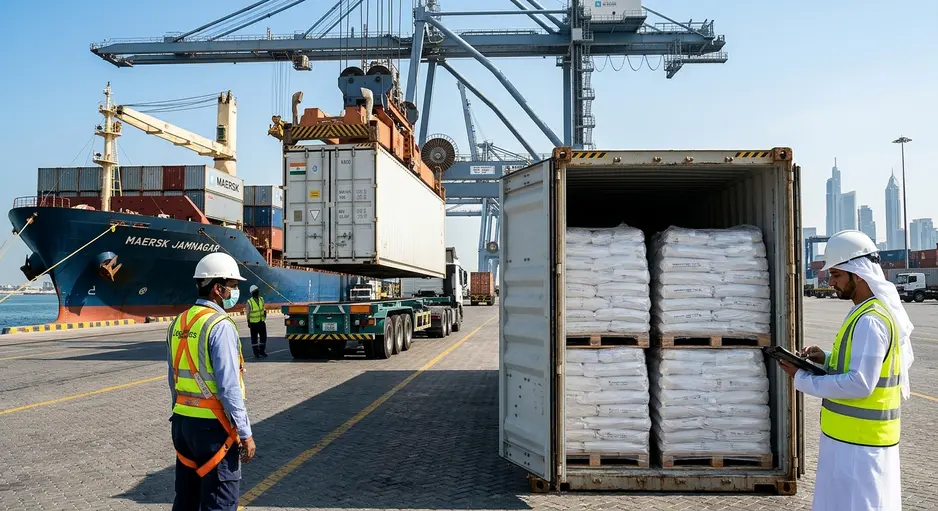
A detailed request for quotation helps prevent delays and unsuitable offers. Indian kaolin clay for UAE buyers should be selected against the actual production need rather than a general product name.
Request a laboratory sample and test it in the intended formulation. After approval, agree on the matching process between the sample and commercial shipment. A trial container can reduce risk before a long-term supply program begins.
Buyers looking for a kaolin clay Supplier from India to UAE can contact Jay Ganesh Minerals with their application, specification, quantity, packaging, and destination port. They should request current technical details, sample availability, and quotation terms directly.
Kaolin Clay Exporter & Supplier to UAE
Selecting a kaolin clay exporter & supplier requires technical testing and commercial care. Review composition, iron, particle size, brightness, moisture, residue, application performance, packaging, and delivery terms as one complete package.
Ask for current documents, test a representative sample, and set clear acceptance ranges before ordering at scale. UAE manufacturers can then approach Jay Ganesh Minerals with a precise RFQ and evaluate the available material using verified evidence. This process helps reduce supply risk while supporting stable production and better long-term value.
Manufacturers, mineral processors, traders, and export businesses may supply the UAE. Buyers should compare specifications, quality controls, packaging, documents, and commercial terms. Jay Ganesh Minerals may be contacted for current information, subject to technical and commercial verification.
The best grade depends on the body formulation, firing temperature, desired whiteness, plasticity, shrinkage, casting behaviour, and iron content. A laboratory test and production trial should be completed before bulk approval.
Kaolin and other kaolinic clays are generally covered by HS heading 2507, whether or not calcined. The importer should confirm the precise code and current duty treatment with a qualified UAE customs broker.
Common documents include the invoice, packing list, bill of lading, certificate of origin, analysis certificate, and safety data sheet. Requirements can vary by port, emirate, buyer, product, and customs procedure.
Some processors may offer different particle-size ranges or packing formats. Buyers must confirm feasibility, tolerances, minimum quantity, added processing costs, and lead time directly with the supplier.

Whatsapp Chatx
Hi! Click one of our representatives below to chat on WhatsApp or send us email to jrt@jayganeshminerals.com

|
Mr. RAJESH +91 99130 87000 |
|
|
Mr. JIGNESH +91 89800 70055 |