Kaolin Clay Exporter & Supplier from India to UAE
02 November, 2026

05 October, 2026
Kaolin quality can vary widely from one deposit to another. The way the clay is processed also affects its purity, color, particle size, and industrial performance. This makes the choice between washed kaolin vs raw kaolin more complex than simply selecting the whiter product.
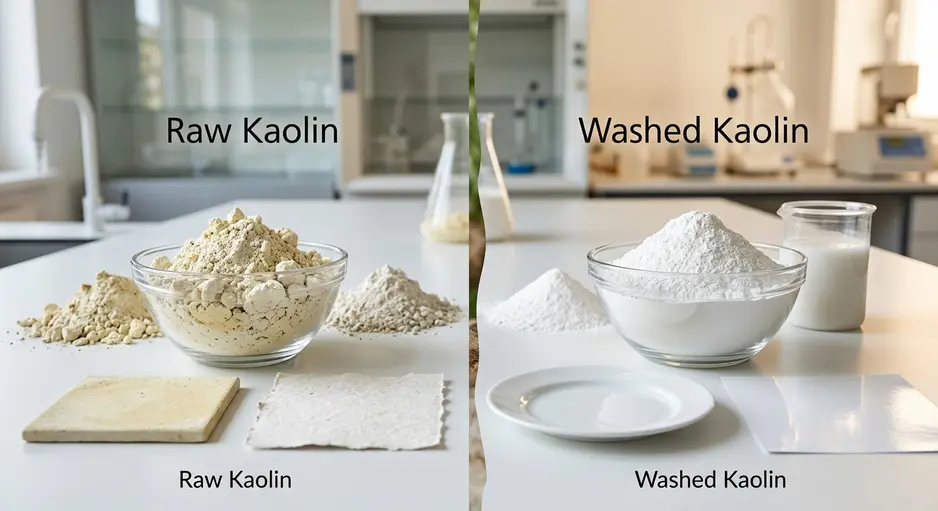
Raw kaolin is generally sold in its natural or minimally processed form. Washed kaolin goes through wet beneficiation to remove grit, classify particles, and reduce selected impurities. Neither type is right for every use. The best option depends on the final product, required specifications, processing costs, and plant conditions.
Buyers should always confirm performance through laboratory results, a certificate of analysis, and production trials.
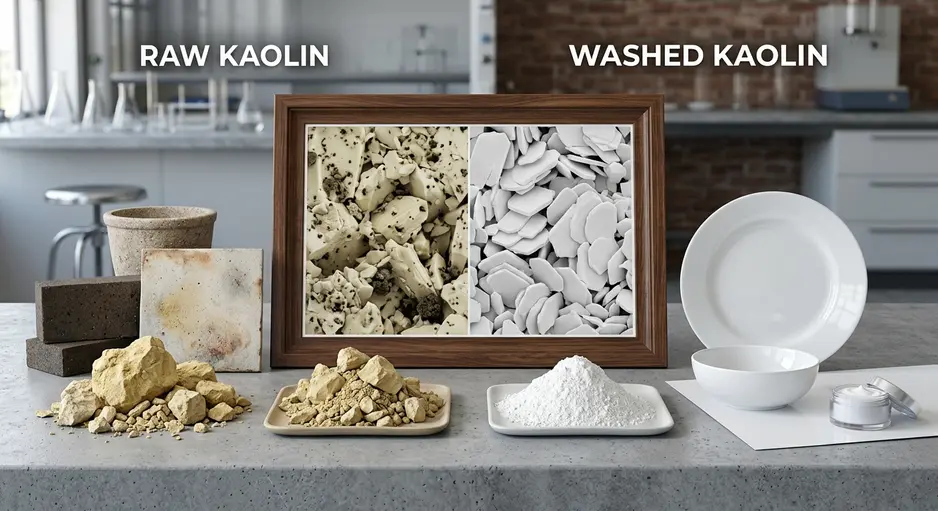
Washed kaolin: Wet-beneficiated, classified, filtered, and often dried or milled.
Raw kaolin: Mined material that may be dried, crushed, screened, or pulverized without wet purification.
Washed kaolin: Usually has a higher or more consistent kaolinite concentration.
Raw kaolin: Purity depends heavily on the deposit and ore selection.
Washed kaolin: Often has a finer, more controlled particle size distribution and lower coarse residue.
Raw kaolin: May contain more quartz, grit, and variation between batches.
Washed kaolin: Usually has better whiteness and brightness, but it also tends to cost more.
Raw kaolin: May have a cream, grey, or off-white color and can offer a lower material cost.
These points describe common tendencies, not guaranteed specifications. A high-quality natural deposit may outperform a poorly processed washed grade.
Washed kaolin clay is a beneficiated industrial mineral. The mined clay is mixed with water, dispersed, and separated from coarse or unwanted material. Further treatment may reduce iron-bearing minerals, titanium minerals, mica, quartz, and organic matter.
This clay purification process can improve kaolinite concentration, brightness, particle consistency, and overall industrial mineral performance. Depending on the production route, the material may be supplied as slurry, filter cake, noodles, dried lumps, or fine powder.
Raw kaolin clay is mined kaolin that has not undergone wet beneficiation. However, “raw” does not always mean untouched ore. A raw product may still be sun-dried, mechanically dried, crushed, screened, or milled before sale.
Grade names are not standardized across all suppliers. One raw kaolin supplier may offer screened lumps, while another may describe a fine dry-milled powder as raw. Buyers should ask for the actual process route and test data.
No. Washed kaolin is purified through wet processing. Calcined kaolin is heated at a controlled temperature to change properties such as hardness, opacity, brightness, and chemical reactivity. Surface-treated kaolin is modified for better compatibility with a specific formulation.
A product can be washed first and then calcined, but the two processes serve different purposes.
The exact process depends on the ore and target market. A common wet-processing route includes:
The U.S. EPA’s AP-42 guidance on clay processing describes crushing, grinding, drying, classification, and related mineral-processing operations. The exact equipment and sequence vary between plants.
Kaolin ore may contain quartz, mica, feldspar, coarse silica, iron-bearing minerals, titanium-bearing minerals, and organic matter. Screening and classification can remove coarse particles. Magnetic separation and other methods may reduce specific color-forming impurities.
Results depend on how those impurities occur in the ore. Washing cannot always remove finely distributed iron or titanium. For this reason, deposit quality matters as much as processing technology.
Washing does not alter kaolinite crystal chemistry in the same way that heat treatment does. It can change reported bulk chemistry by removing free quartz and other non-kaolinite minerals.
Ideal kaolinite contains about 46.5% silica, 39.5% alumina, and 14% structural water by mass. Commercial kaolin differs from this ideal composition because natural deposits contain other minerals and varying levels of moisture.
Low iron oxide content is important in porcelain, whiteware, paper, and light-colored coatings. Iron may cause cream, yellow, red, or brown tones, especially after firing. Titanium minerals may also affect brightness and fired color.
Brightness and whiteness are related, but they are not identical measurements. Results can vary with the instrument, sample preparation, illuminant, and standard used. Paper-grade buyers should request results based on a stated TAPPI or ISO method rather than comparing numbers without test details.
Washed kaolin is often brighter than untreated clay, but washing cannot guarantee a white product. The original ore remains a key factor.
Important measurements include median particle size, percentage below two microns, top-cut size, and residue on a selected sieve. ISO 13320 or another recognized method may be used for laser-diffraction particle analysis.
Fine, controlled particles help produce smooth paper coatings and uniform paint films. In ceramics, coarse quartz and grit may contribute to surface defects, inconsistent shrinkage, or equipment wear. A narrow particle size distribution may also support more stable viscosity.
Washed kaolin is not automatically more plastic than unprocessed kaolin clay. Plasticity depends on particle shape, fineness, surface area, accessory clay minerals, water demand, and organic content.
Removing very fine minerals can sometimes reduce plastic behavior. Ceramic producers should test workability, casting rate, green strength, drying shrinkage, and cracking rather than judging clay by purity alone.
Kaolin may arrive as dry powder, damp lumps, filter cake, or slurry. These forms have different moisture levels. Buyers should compare price and chemistry on a dry-solids basis.
Moisture affects freight cost, storage, dosing, and ceramic body formulation. Stable moisture also makes it easier to keep production batches consistent.
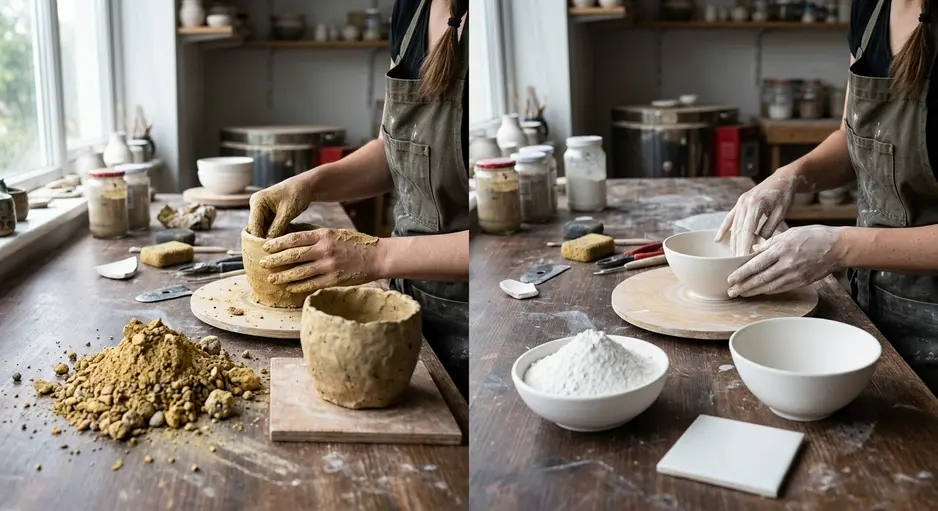
Washed kaolin for ceramics is commonly considered when low iron, controlled residue, predictable shrinkage, and high fired whiteness are important. Possible uses include porcelain, sanitaryware, white tiles, glazes, and electrical ceramics.
For example, a porcelain producer facing dark specks may test a washed grade with lower coarse residue and iron content. A plant trial should still measure casting rate, drying behavior, fired color, strength, glaze response, and warpage.
Yes. Raw kaolin for ceramics can perform well when the deposit meets the body’s needs. It may suit earthenware, bricks, refractories, selected tiles, and products with less strict color requirements.
Manufacturers may blend raw clay with ball clay, feldspar, silica, or washed material to balance plasticity, firing behavior, and cost. The blend should be based on test results rather than a fixed rule.
Washed kaolin for the paper industry may be used as a coating pigment or functional filler. Paper coating applications often need high brightness, low grit, fine particles, good rheology, controlled abrasion, and stable viscosity.
Raw clay is generally less suitable for high-quality coated paper without beneficiation. Coarse particles can reduce surface smoothness and may increase wear on processing equipment.
Paint and coating applications use kaolin to support sheen control, suspension, film properties, and extender performance. Rubber and plastic formulations may use it for reinforcement, dimensional stability, and cost control. It can also provide filling and rheology benefits in adhesives and sealants.
Raw kaolin for industrial use may be practical in refractories, bricks, construction products, and other formulations where bright color and very fine particles are not essential.
Choosing kaolin clay for industrial applications starts with clear limits. Depending on the use, buyers may need to define:
A low purchase price does not always mean a lower operating cost. Consider freight, moisture, milling, energy use, reject rates, filter wear, nozzle wear, and batch variation.
A more consistent processed kaolin clay may reduce defects and downtime. In another process, an economical raw grade may meet every requirement without added treatment.
Whether assessing a washed kaolin supplier or raw kaolin supplier, request a technical data sheet, safety data sheet, chemical analysis, particle-size report, moisture result, and brightness or whiteness report where relevant.
Jay Ganesh Minerals can be contacted to discuss application needs, available kaolin grades, technical specifications, samples, and supply options. Final approval should be based on verified data and trials under the buyer’s own production conditions.
Explore Washed Kaolin & Raw Kaolin
The choice between washed kaolin vs raw kaolin should be based on the deposit, processing route, verified properties, and final application. Washed material generally provides controlled particles, lower grit, and more consistent performance. Raw material can be a cost-effective choice for suitable ceramic, refractory, construction, and general industrial products.
Do not rely on grade names alone. Compare test methods, dry-solids cost, plant performance, and finished-product quality. Contact Jay Ganesh Minerals to discuss specifications or arrange a sample evaluation for your application.
Not for every use. Washed material usually offers lower grit and better consistency. Raw material may be more economical when color, purity, and particle-size limits are less demanding.
No. It is often whiter, but the result depends on the deposit and the form of the iron- or titanium-bearing minerals.
Yes. Test it for plasticity, water demand, drying shrinkage, fired color, strength, and coarse residue before regular use.
Washed kaolin is purified through wet beneficiation. Calcined kaolin is heated to change its physical and chemical properties.
Particle size affects smoothness, viscosity, plasticity, abrasion, opacity, suspension, and finished-product consistency.

Whatsapp Chatx
Hi! Click one of our representatives below to chat on WhatsApp or send us email to jrt@jayganeshminerals.com

|
Mr. RAJESH +91 99130 87000 |
|
|
Mr. JIGNESH +91 89800 70055 |