
Global Industrial Mineral Trends in 2026
02 July, 2026

02 June, 2026
Kaolin clay, often called china clay, plays a key role in modern papermaking. It is widely used as both a filler and a coating pigment, helping paper mills achieve the right balance of brightness, smoothness, and print quality. Despite new materials entering the market, kaolin clay for paper industry applications remains a top choice because of its natural properties and reliable performance.
From glossy magazines to packaging boards, different kaolin clay grades serve specific purposes. Manufacturers rely on its fine particle size, high brightness, and excellent dispersion behavior to improve paper quality while controlling costs. Sourcing also matters, as global supply hubs like India, the USA, and China offer different quality levels and pricing structures.
This guide explains how kaolin works in papermaking, the types available, and how to choose the right supplier for consistent results.
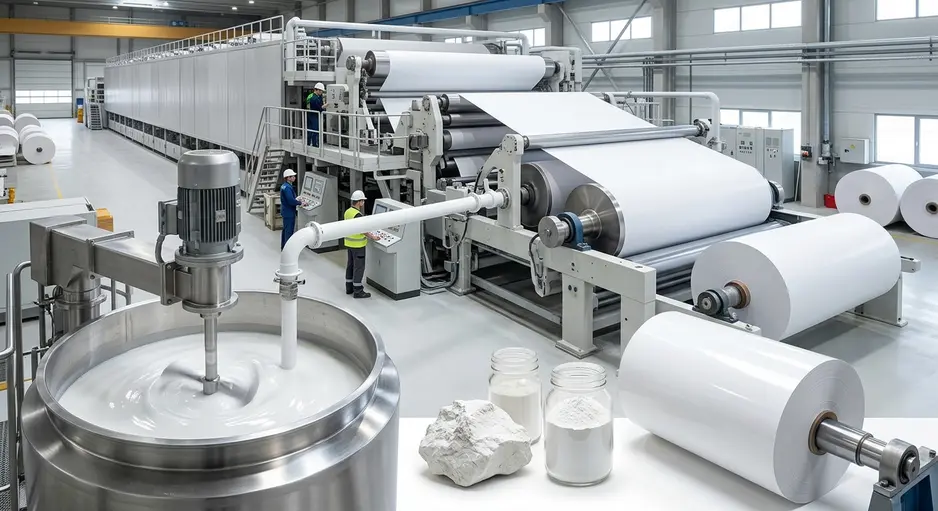
Kaolin is a naturally occurring mineral made mainly of kaolinite. It has a layered silicate structure that gives it softness, fine particle size, and high whiteness. These properties make it ideal for paper applications where surface quality and brightness matter.
Kaolin serves two main roles in paper production:
Hydrous kaolin paper filler is commonly used inside the sheet, while coating grade kaolin is applied on the surface.
Calcium carbonate is often compared with kaolin clay. While it offers high brightness at lower cost, kaolin provides better control over surface finish and ink absorption. Many mills use a blend of both to balance performance and cost.
Kaolin enhances paper brightness and opacity, making printed text and images sharper. High brightness kaolin for paper mills is especially valuable in premium printing grades.
The fine particle structure of kaolin fills gaps between fibers, creating a smooth surface. This improves ink absorption and reduces ink spread, resulting in cleaner prints.
As a coating pigment, kaolin helps control gloss and surface finish. It allows manufacturers to produce anything from matte to high-gloss paper depending on formulation.
Kaolin improves sheet formation and machine efficiency. Its consistent particle size distribution supports better drainage and fewer defects during production.
Using kaolin reduces the need for expensive fibers while maintaining quality. This makes it a cost-effective mineral filler for paper production.
Hydrous kaolin is the natural form of kaolin. It is widely used as a filler due to its good brightness and cost-effectiveness.
Calcined kaolin is heat-treated to enhance brightness, opacity, and light scattering. It is often used in coatings.
Coating grade kaolin requires tight control over particle size and whiteness. It delivers smooth surfaces and consistent gloss levels.

Kaolin is often supplied as a slurry for easy mixing in coating formulations. Proper dispersion ensures uniform coverage and consistent quality.
Kaolin works with binders and additives in surface sizing. It enhances coating structure and improves adhesion to the base sheet.
Fine particles increase gloss, while coarser particles improve opacity. This balance is key in producing coated paper.
Good dispersion prevents agglomeration and ensures smooth coating. Rheology control helps maintain stable viscosity during application.
Paper mills often rely on bulk kaolin clay suppliers for consistent supply. Wholesale kaolin clay for papermakers ensures cost stability and long-term availability.
Pricing depends on several factors:
On average, export prices can vary widely depending on specifications and volume.
Reliable suppliers such as Jay Ganesh Minerals offer consistent quality and support for paper manufacturers seeking dependable raw materials.
High grade minerals are essential for premium printing and publishing applications.
Glossy paper requires finer particles and higher brightness, while packaging board can use coarser and lower-cost grades.
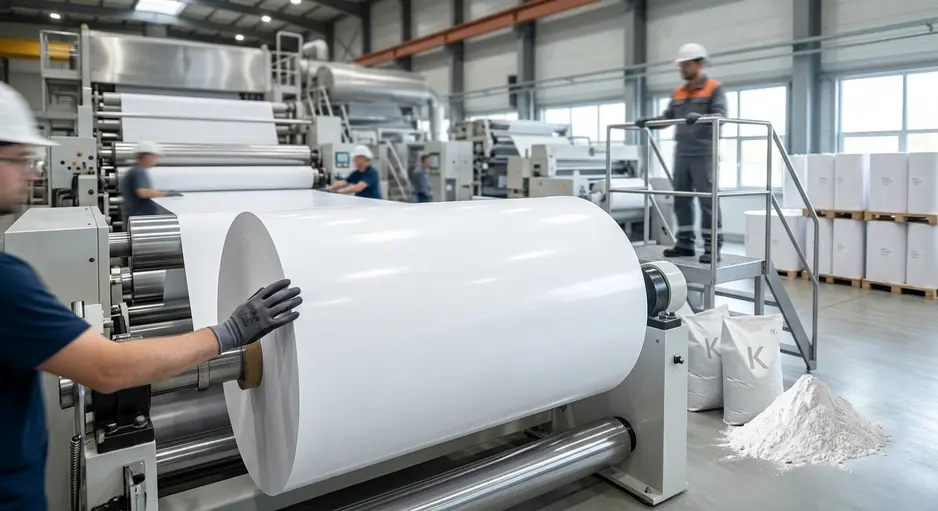
Kaolin is mined and then refined to remove impurities. Beneficiation improves brightness and purity.
Processing includes particle size classification and, in some cases, calcination to enhance properties.
Strict quality control ensures consistency in particle size and whiteness. Technical data sheets help buyers evaluate suitability.
The supply chain involves mining, processing, packaging, and global distribution. Reliable logistics ensure timely delivery to paper mills.
Buy Kaolin Clay for Paper Manufacturing
The demand for high-performance paper continues to grow, especially in printing and packaging. Kaolin clay remains a key material due to its versatility and performance benefits. As sustainability becomes more important, manufacturers are also focusing on eco-friendly mineral fillers and efficient processing methods.
Choosing the right kaolin clay grades and working with reliable suppliers ensures consistent product quality and operational efficiency. Companies like Jay Ganesh Minerals provide dependable solutions for paper manufacturers seeking high-quality kaolin for global supply.
Investing in the right kaolin sourcing strategy can significantly improve paper quality while keeping production costs under control.
Kaolin is used as a filler and coating pigment to improve brightness, smoothness, and print quality.
Kaolin can replace or complement calcium carbonate depending on the desired properties.
Calcined kaolin is heat-treated for higher brightness and opacity, while hydrous kaolin is natural and more cost-effective.
It reduces fiber usage, improves opacity, and enhances surface properties.
Prices vary widely depending on grade and quality, typically ranging from moderate to premium levels.
It depends on the application, but finer particles are preferred for high gloss and smooth finishes.

Whatsapp Chatx
Hi! Click one of our representatives below to chat on WhatsApp or send us email to jrt@jayganeshminerals.com

|
Mr. RAJESH +91 99130 87000 |
|
|
Mr. JIGNESH +91 89800 70055 |