
Indonesian Coal Grades Explained and Their Applications
06 August, 2026

03 May, 2026
In the world of ceramic manufacturing, understanding the differences between ball clay and kaolin clay is critical for achieving consistent quality, strength, and surface finish. Over the past decade working closely with ceramic tile manufacturers and export houses.
This comprehensive guide explains the uses of ball clay, the uses of kaolin clay, and the technical differences that matter most in tile body formulation. If you are sourcing raw materials for tiles, sanitaryware, porcelain, or whiteware, this breakdown will help you make data-driven decisions.
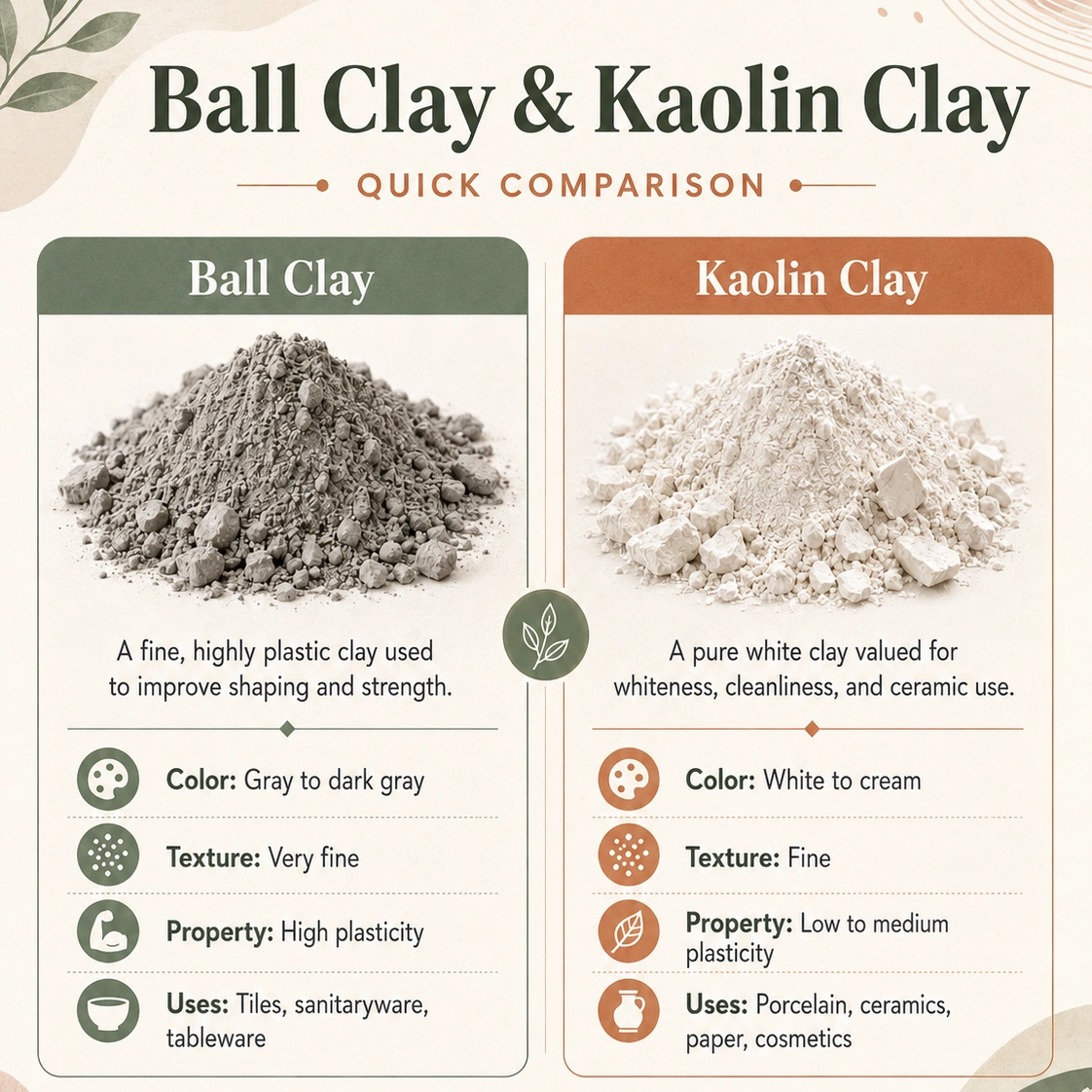
Ball clay is a fine-grained, highly plastic sedimentary clay primarily composed of kaolinite, along with mica, quartz, and small amounts of organic matter. It is widely valued for its exceptional ball clay plasticity properties, which improve workability in tile body formulation.
Based on extensive industry work, ball clay is often sourced from deposits.
Kaolin clay, is primarily composed of the mineral kaolinite. It is chemically purer than ball clay and contains very low levels of organic impurities.
In kaolin mining India, high-brightness grades are processed for ceramic and industrial applications. Due to its excellent refractory properties of kaolin, it withstands high firing temperatures, making it ideal for porcelain body formulation.
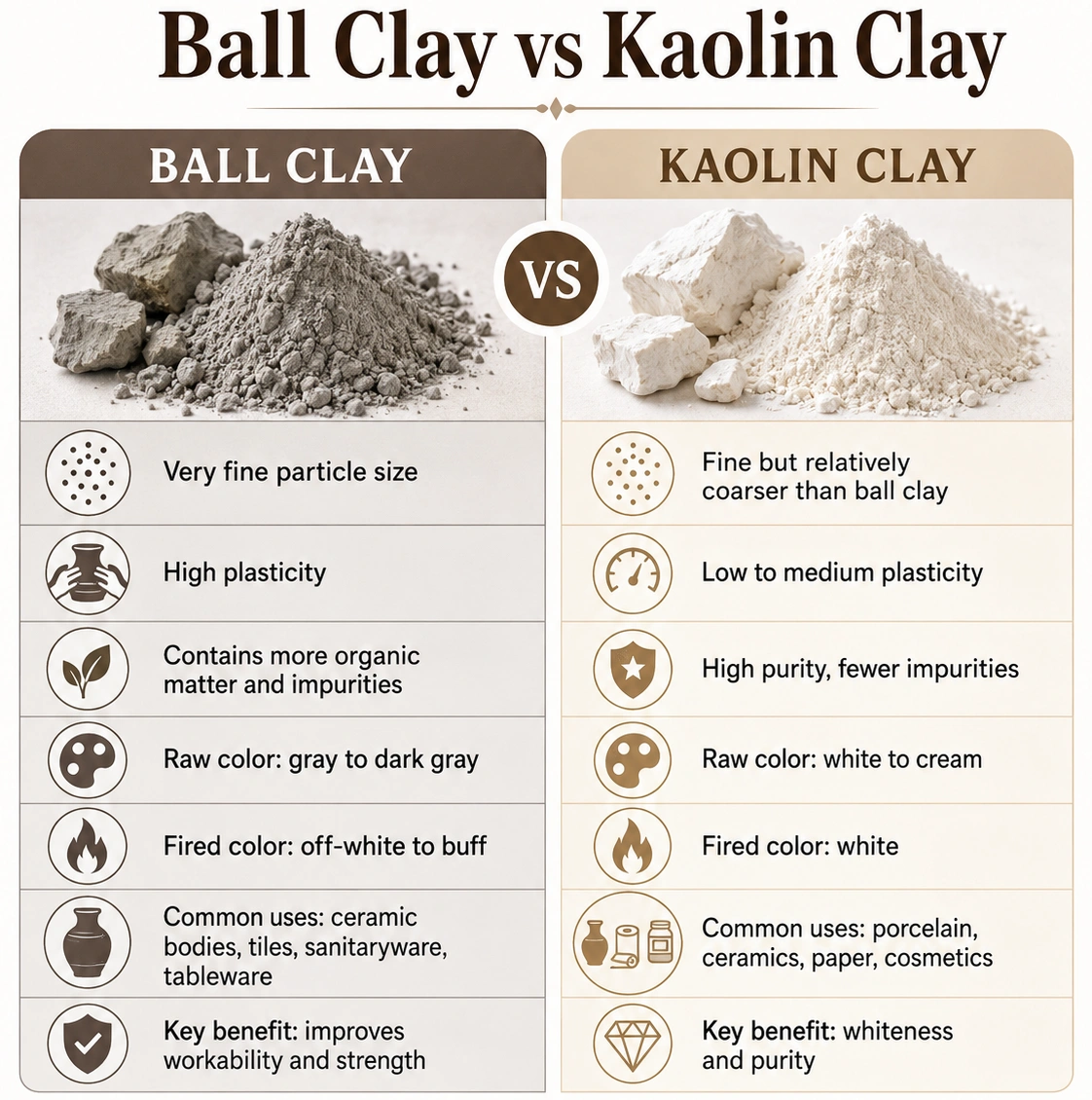
Understanding kaolinite vs ball clay mineral differences is essential for ceramic engineers. While both contain kaolinite, ball clay includes additional minerals and organic content that increase plasticity but reduce whiteness.
When evaluating ball clay vs kaolin for ceramic tiles, plasticity is often the first deciding factor. Ball clay significantly improves molding behavior and reduces cracking during shaping.
In over a decade of experience optimizing ball clay tile body formulation, I’ve found that incorporating 20-40% ball clay in standard ceramic tiles delivers optimal green strength.
Ball clay increases dry strength but also contributes to higher shrinkage. Kaolin, due to its purity, provides better control in porcelain body formulation.
Proven strategies include blending kaolin for structure and ball clay for plasticity, ensuring mechanical strength without excessive warpage.
Kaolin glaze raw material grades are widely used in ceramic glaze additives to improve suspension and brightness. Ball clay, being a fine particle clay for glaze, enhances adhesion and workability in slip casting clay mixtures.
The primary uses of ball clay in ceramics include tile manufacturing, sanitaryware, and porcelain. It acts as a binder and improves green strength.
For slip casting clay mixtures, ball clay ensures superior casting rates and mold release. Industrial ball clay suppliers for tiles often provide customized grades for casting applications.
The key uses of kaolin clay include high-end porcelain tiles and sanitaryware. Kaolin for porcelain tiles ensures whiteness and translucency demanded by export markets.
As a kaolin glaze raw material, it improves opacity and suspension. It is also used as a fine particle clay for glaze formulations.
Beyond ceramics, kaolin serves paper coating, rubber reinforcement, and pharmaceutical applications due to its chemical purity.
Based on extensive industry work, the best clay mix for ceramic tiles typically includes:
Choosing between ball clay and kaolin clay is not about selecting one over the other. It’s about understanding their mineralogy, performance characteristics, and application requirements.
In over a decade of experience supporting ceramic tile manufacturers raw materials India and export-focused producers, the most successful companies strategically blend both materials. By understanding the uses of ball clay and the uses of kaolin clay, manufacturers can optimize strength, surface finish, and cost efficiency.
The main difference lies in plasticity and purity. Ball clay offers higher plasticity and dry strength, while kaolin clay provides better whiteness and refractory performance.
It depends on the tile type. For standard ceramic tiles, ball clay improves workability. For porcelain tiles requiring whiteness, kaolin is essential.
Not entirely. Due to differences in kaolinite vs ball clay mineral differences, porcelain requires kaolin for whiteness and structural integrity.
A balanced combination of ball clay, kaolin clay, feldspar, and quartz delivers optimal strength, shrinkage control, and surface finish.

Whatsapp Chatx
Hi! Click one of our representatives below to chat on WhatsApp or send us email to jrt@jayganeshminerals.com

|
Mr. RAJESH +91 99130 87000 |
|
|
Mr. JIGNESH +91 89800 70055 |