

Indonesian Coal Grades Explained and Their Applications
06 August, 2026

06 August, 2026
Ball clay is an important ceramic raw material used in tableware, porcelain, and sanitaryware bodies. Its fine particles help improve plasticity, binding, and strength before firing. Yet ceramic producers need more than a highly plastic clay. They also need controlled chemistry, suitable particle size, stable fired color, and reliable batch consistency.
Choosing a ball clay manufacturer for the tableware industry or sanitaryware production requires careful testing. The right grade must work with the complete body recipe, forming process, water chemistry, and firing cycle. This guide explains the main properties of ceramic grade ball clay, its role in production, and the points buyers should review before approving a supplier.
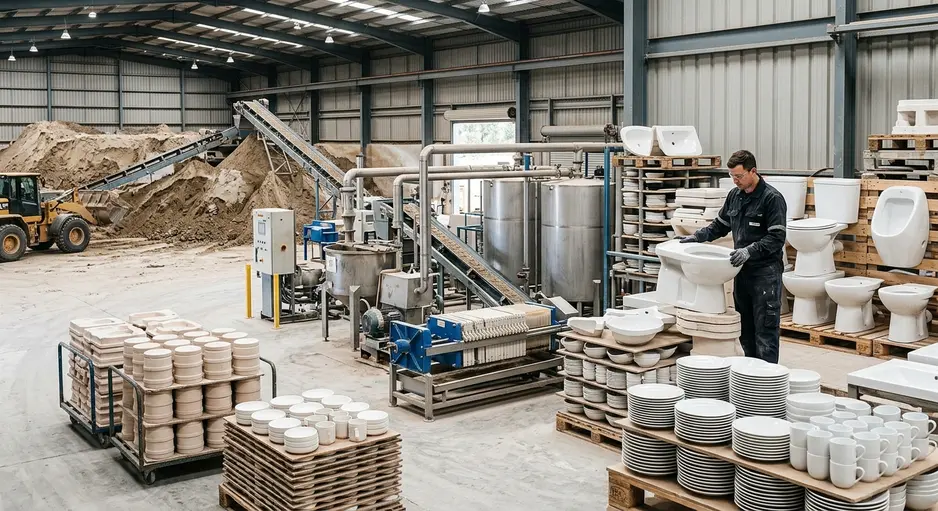
Ball clay has very fine particles that create cohesion when mixed with water. This gives the ceramic body better workability during shaping, casting, trimming, and handling.
Its most useful contribution is often improved green strength. Green strength refers to the strength of an unfired ceramic body. It helps pieces keep their shape as they are removed from moulds, transferred between stations, or prepared for firing.
This property is valuable for thin tableware, large sanitaryware pieces, and complex ceramic shapes. Weak green bodies may crack, bend, or break before they reach the kiln.
A fine particle size clay can fill spaces between coarser raw materials in a ceramic body formulation. It may improve binding and support a more uniform body. The high surface area can also affect suspension and forming behavior.
However, finer is not always better. Very fine or highly plastic material may increase water demand and drying shrinkage. The grade must match the production method and the other minerals in the recipe.
Fired color is important in white tableware, porcelain, and sanitaryware. Buyers often look for white-firing ball clay with controlled levels of iron and other coloring minerals.
Low iron ball clay can support a lighter fired appearance, but chemistry alone does not guarantee whiteness. The final color also depends on mineralogy, firing temperature, kiln atmosphere, glaze, and the rest of the ceramic body.
Fired-color results should always state the testing temperature and method. A sample tested under one firing cycle may behave differently in another plant.
A premium ball clay should provide useful plasticity without creating excessive drying problems. Producers must assess plasticity, dry shrinkage, drying sensitivity, green strength, fired shrinkage, and deformation together.
A high plasticity ball clay may improve binding, but it can also require more water. More forming water may lead to longer drying cycles or greater dimensional change. Production trials are therefore more useful than judging clay from a single value.
Particle-size distribution gives more useful information than mesh size alone. A mix of particle sizes can affect body packing, slip viscosity, casting rate, drainage, and surface finish.
Residue and oversize particles should also be reviewed. Unwanted coarse material may cause surface defects, weak points, or processing problems. Refined ball clay should be assessed for both fine-particle behavior and residue control.
Results should be supported by current laboratory reports, clear test methods, and representative samples. Buyers should also compare several batches rather than relying on one certificate of analysis.
Ball clay for the tableware industry supports forming and handling in processes such as pressing, jiggering, jollying, and slip casting. Better green strength can reduce edge damage and breakage before firing.
Tableware producers must also consider fired whiteness, surface smoothness, warpage, glaze fit, and mechanical strength. A clay that forms well but affects color or glaze quality may not be suitable for the final recipe.
In porcelain bodies, ball clay is commonly blended with kaolin, feldspar, silica, and other ceramic minerals. Kaolin often contributes whiteness and refractoriness, while ball clay provides more plasticity and binding strength.
The correct balance varies by product, forming process, and firing cycle. A body for cast tableware may require different behavior from a body used for pressed or plastic-formed products.
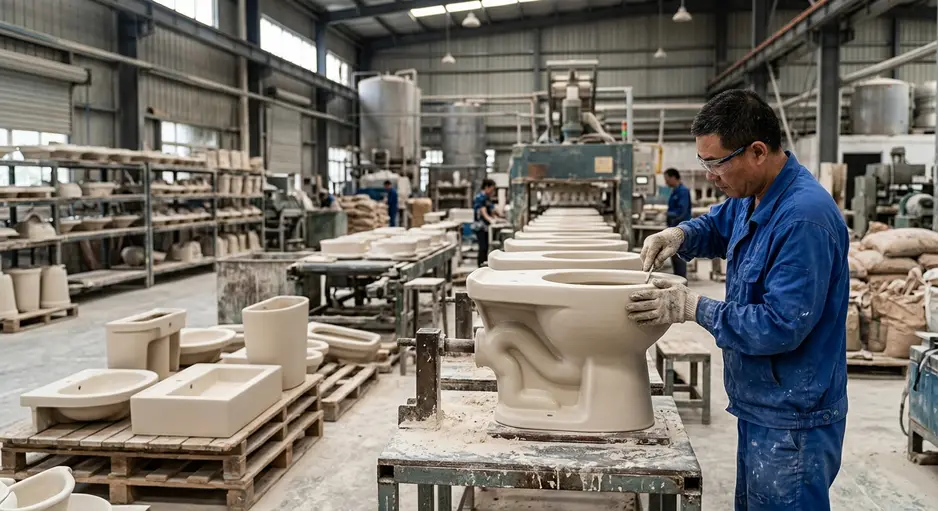
A sanitaryware ceramic body must produce stable casting behavior while developing enough strength for demoulding and handling. Large pieces also need dimensional stability during drying and firing.
Important production factors include slip viscosity, thixotropy, casting rate, drainage, mould release, green strength, fired deformation, and consistent appearance. Each factor can influence cycle time and rejection rates.
Ball clay for the sanitaryware industry can support suspension, plasticity, and unfired strength. Its interaction with deflocculants and process water must be tested carefully during casting slip preparation.
A highly plastic clay may raise water demand if it is not balanced correctly. This can affect viscosity, drain time, drying speed, and shrinkage. Laboratory slips should use the plant’s actual water and additives whenever possible.
There is no universal percentage for ball clay in a ceramic body. The right amount depends on kaolin quality, fillers, fluxes, forming method, process water, deflocculants, and the firing schedule.
Small laboratory trials should be followed by pilot-scale validation. A change that works in a test sample may behave differently in full-size sanitaryware or under normal factory conditions.
Ball clay and kaolin are both kaolinitic ceramic clays, but ball clay is generally finer and more plastic. Kaolin is usually less plastic and is valued for whiteness, purity, and refractoriness.
Many ceramic bodies use both because their properties complement each other. One should not be treated as a direct replacement for the other. Any substitution must be checked through forming, drying, firing, and glaze tests.
A dependable ball clay supplier should provide enough information for technical qualification. Buyers should request a certificate of analysis, sampling details, test methods, fired-color data, and batch identification.
Consistency across shipments matters as much as the result from one sample. Changes in moisture, residue, particle size, iron, or plasticity can alter casting and firing behavior.
A capable ball clay manufacturer for the sanitaryware industry should recognize that casting bodies have different needs from pressed or jiggered tableware. Buyers can ask the following questions:
A lower purchase price may not reduce total production cost. Inconsistent industrial ball clay for ceramic manufacturing can contribute to casting variation, cracks, warpage, color changes, and unplanned recipe adjustments.
Qualification should focus on process stability, finished quality, rejection rates, and supply reliability. The best commercial choice is the grade that performs consistently in the buyer’s actual production system.
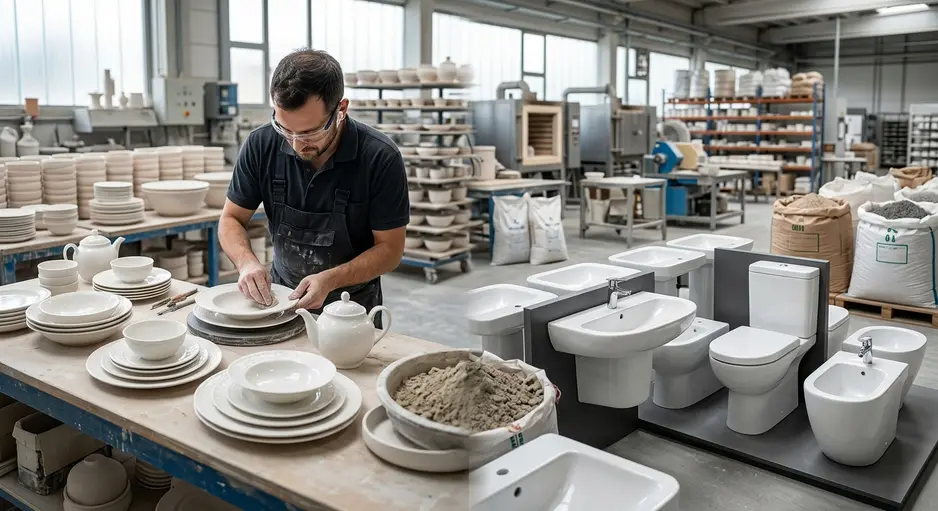
Companies evaluating a ball clay exporter should confirm packing, moisture protection, shipment identification, and container-loading arrangements. Clear documents help importers receive and trace each order.
An international ball clay supplier should also clarify minimum order quantities, available packing formats, dispatch points, shipment lead times, and the process used if material falls outside an agreed specification.
Ball Clay Manufacturer Industry
The right ball clay for ceramic products should balance plasticity, green strength, particle size, shrinkage, fired appearance, and process compatibility. A generic specification cannot replace trials in the buyer’s own body, water system, forming line, and kiln cycle.
Businesses considering Jay Ganesh Minerals can request a technical specification, representative sample, packaging information, and quotation for tableware or sanitaryware applications. Comparing documented results through laboratory and pilot testing provides a sound basis for supplier approval and long-term production use.
It is used to improve plasticity, binding, and green strength in tableware ceramic production. It supports forming and handling before firing. The selected grade must also meet requirements for fired color, surface finish, shrinkage, and glaze compatibility.
It can improve suspension, plasticity, and unfired strength in a sanitaryware body. These properties support casting, demoulding, trimming, and handling. Its effect on viscosity, casting rate, water demand, and shrinkage must be confirmed through trials.
Yes. Ball clay is often used in porcelain blends to provide plasticity and binding strength. Its iron content, fired color, particle size, shrinkage, and processing behavior should match the required porcelain quality.
Ball clay mainly improves green or unfired strength. Fired strength depends on the complete recipe, vitrification level, firing temperature, kiln cycle, and final microstructure. It should not be evaluated as an isolated ingredient.
A white-firing grade generally has controlled coloring impurities. However, the final shade also depends on mineralogy, firing temperature, kiln atmosphere, and interactions with other raw materials. Buyers should request fired samples tested under relevant conditions.

Whatsapp Chatx
Hi! Click one of our representatives below to chat on WhatsApp or send us email to jrt@jayganeshminerals.com

|
Mr. RAJESH +91 99130 87000 |
|
|
Mr. JIGNESH +91 89800 70055 |